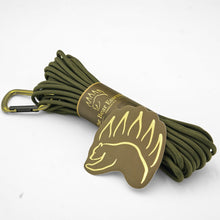


How to Tie the Paracord Wrap (Short Hank)
Usage
The Paracord Wrap (Short Hank) is a quick way to coil thin rope under 50 ft (15 m) into a compact bundle that stores neatly and pays out without tangling. You wind the cord into a hand-sized hank, then lock it with a finish commonly called a clove hitch — which is why the whole technique is also known as a "Fisherman's Wrap." It has a genuine pedigree: Ashley catalogued it as entry #3097, the fisherman's coil, "the coil often seen in fishermen's shacks."
Why Learn the Paracord Wrap (Short Hank)?
Loose paracord in a pack turns into a rat's nest. The Paracord Wrap (Short Hank) fixes that with nothing but the cord itself — no spool, no band, no clip. Wind it once and the hank sits in a pocket or gear bin until you need it; pull the right end and the cord comes off clean.
It also earns its "quick" billing: the wind takes as long as the cord is, and the finish is two moves. For anyone who carries pre-cut lengths of cordage — guy lines, ridge lines, spare paracord — it's the storage habit that pays off every single trip.
Common Uses
Camping and Bushcraft
- Easy paracord storage — short lengths bundled tangle-free between trips.
- Tangle-free deployment of guy lines and spare cordage.
- Managing pre-cut working lengths around camp — one long-time user cuts 100 ft (30 m) into six hanks of about 16.6 ft (5 m) each for tent lines and gear-drying runs.
Household / Workshop
- Keeping short lengths of thin cord and twine bundled in a drawer or gear bin.
Historical
- Stowing short lines for dead storage — Ashley records it as the coil commonly found in fishermen's shacks.
ABOK Number
(Ashley Book of Knots)
Other Names
Category
Variations |
Notable Features
- Quick: A palm wind plus a two-move finish — the fastest way in our coiling family to put away a short hank.
- Self-contained: The cord secures itself; no spool, rubber band, or clip needed.
- Tangle-free pay-out: Pull the starting end and the cord dispenses cleanly.
- Right-sized for paracord: Works very well for short paracord hanks — thin rope under 50 ft (15 m) is its design case.
Security Level
This is a storage technique, not a load-bearing knot, so security here just means the coil staying bundled. Drawn up snugly it holds fine for everyday carry, but Ashley himself rated #3097 below its neighbor the Sailor's Coil (#3098) for standing up to rough handling — for hanks that get manhandled in long-term storage, a more secure coil finish is the better pick.
Downsides
- Wrong end tangles it: Deploying from the tied-off end instead of the starting end may cause tangles — the one real way to ruin this wrap.
- Short lengths only: One experienced user found it works well at campsite lengths around 16 ft (5 m) but isn't fully satisfying at 50–100 ft (15–30 m) of thin cord. Longer lines want a long-hank or coil method instead.
- Needs a snug finish: Ashley's own note — it "must be drawn up snugly and carefully adjusted," or the coil works loose.
History
The Paracord Wrap (Short Hank) is one of the few modern-named coiling techniques with its own dedicated entry in The Ashley Book of Knots (1944): #3097, the fisherman's coil, listed among the dead-storage coils. Ashley was candid about it — the finish is commonly but loosely called a clove hitch (his actual instruction is a round turn plus a half hitch), and the coil is routinely confused with the more secure Sailor's Coil next door at #3098. The same idea keeps resurfacing on its own: a 2011 forum poster described the version his father taught him, and a 2019 paracord-retailer blog teaches a matching "Magic Hank" — folk knowledge that keeps getting reinvented.
How to Tie a Paracord Wrap (Short Hank)

Step 1
Wind the cord into a compact bundle by hand — around your palm, adding crossing turns as you go.
Step 2
With the working end, take a round turn around the coiled bundle, wrapping to the left.
Step 3
Follow with a half hitch, also to the left. This is the finish everyone calls a clove hitch — Ashley notes the name is loose, but the lock is the same idea.
Step 4
Draw the finish up snugly and adjust it so it grips the bundle, leaving the starting end where you can find it. Done — the hank is ready for a pocket or pack.
Pro Tip: When it's time to deploy, pull the starting (loose) end — the one you began winding with — never the tied-off end, or the rope will tangle.
If the wind or the finish isn't clicking from flat steps, the Knot IQ app has the Paracord Wrap (Short Hank) as a full 3D animation you can slow down and orbit until the wrap makes sense. And it practices best on the real thing — a hank of Premium Bushcraft Paracord is exactly the thin, supple cord this technique was made for.
FAQ
What is the Paracord Wrap (Short Hank) used for?
Storing short lengths of thin rope — under about 50 ft (15 m), paracord especially — in a compact bundle that deploys without tangling. It's the same technique Ashley catalogued as the fisherman's coil for stowing down short lines.
Which end do you pull to unravel a paracord hank?
The starting (loose) end — the one you began winding with. Pulling the tied-off end tangles the rope.
Is the finish on this wrap really a clove hitch?
Commonly it's called one — but Ashley's actual instruction for #3097 is a round turn followed by a half hitch, both to the left, and he notes the clove-hitch label is a loose common name. Some community versions do finish with a true clove hitch; both lock the bundle.
Does the Paracord Wrap (Short Hank) work for long ropes?
It's fenced to thin rope under about 50 ft (15 m). One long-time user reported the wrap works well at campsite lengths of around 16 ft (5 m) but isn't fully satisfying at 50–100 ft (15–30 m) of thin cord — for longer lines, use a long-hank or coil method instead.
Is the Paracord Wrap (Short Hank) in the Ashley Book of Knots?
Yes — it's ABOK #3097, "A fisherman's coil," in Ashley's run of rope-storage coils (#3083–#3113). He calls it the coil often seen in fishermen's shacks.


