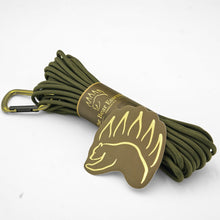


How to Tie the Paracord Wrap (Long Hank)
Usage
The Paracord Wrap (Long Hank) is a figure-eight style hand wrap for storing thin rope longer than 50 ft (15 m). Wound this way, a long run of paracord packs down into one flat bundle that rides in a pack or bin and pays out tangle-free when you need it — provided you pull the starting end, not the tied-off end.
Why Learn the Paracord Wrap (Long Hank)?
Long thin cord has a tangling problem short lengths don't, and simply scaling up a pocket hank doesn't fix it. The figure-eight wind is the answer: every turn reverses the twist the previous one put into the cord, so the twist that causes kinks and tangles never builds up.
If you keep a long hank of bushcraft paracord in your camp kit, this wrap is how it stays usable instead of turning into a bird's nest.
Common Uses
Camping and Bushcraft
- Storing long lengths of paracord — 50 ft (15 m) and up — compactly between trips.
- Tangle-free deployment of guy lines and camp cordage.
Household / Workshop
- Keeping bulk utility cord tidy in a bin or drawer until a job calls for it.
Other Names
Category
Variations |
Notable Features
- Built for Length: A quick way to coil thin ropes over 50 ft (15 m) — the range where ordinary hand coils start fighting you.
- Twist-Cancelling Wind: The figure-eight pattern reverses the twist of each previous turn, which is why the cord resists kinking at length.
- Paracord's Best Friend: Works very well for paracord hanks — thin, slippery nylon cord is exactly what this wrap was worked out for.
Similar Knots
Exploding Paracord Wrap vs. Paracord Wrap (Long Hank)
- Advantage: The Exploding Paracord Wrap releases the whole bundle instantly in one motion.
- Disadvantage: Not built for the 50 ft (15 m)+ lengths the long hank handles.
Butterfly Hank (With Button) vs. Paracord Wrap (Long Hank)
- Advantage: Its self-locking button lets you pull out part of the cord and tighten the bundle back down.
- Disadvantage: A hand-sized bundle — it doesn't scale to the long lengths this wrap is made for.
Paracord Wrap (Short Hank) vs. Paracord Wrap (Long Hank)
- Advantage: Faster to wind and pocket-sized for everyday lengths.
- Disadvantage: Scaled up to long cord, short-hank bundles still let the line tangle.
Security Level
This is a storage wrap, not a load-bearing knot, so security just means the bundle staying wound in your pack. The center wraps with the tail tucked through hold fine; the only thing that costs you is deploying from the wrong end, which tangles the rope.
Downsides
- Wrong-End Tangles: Deploying the tied-off end instead of the starting end may cause tangles — the one real failure mode.
- Wind Time Scales with Length: Winding 100 ft (30 m) of cord into even figure-eights takes patience; there's no shortcut around the length itself.
History
There's no classical "Long Hank" — the name appears in no old knot book. What is old is the hank itself: Ashley's Book of Knots (1944) defined a hank as the coil cordage is stored and sold in, made up so "the purchaser may buy the length required without the necessity of rewinding or measuring" — the direct ancestor of today's 50 ft (15 m) and 100 ft (30 m) commercial paracord hanks. The long-length wrapping problem is modern, driven by paracord, and the figure-eight wind was the community's answer.
How to Tie a Paracord Wrap (Long Hank)

Step 1
Tie a loop in one of the free ends of the cord.
Step 2
Hold the loop with your thumb, palm facing toward you.
Step 3
Run the cord down to your pinky finger.
Step 4
Bring the cord around the pinky and back across to the index finger, forming a figure-eight pattern between your index finger and pinky.
Step 5
Repeat the figure-eight wraps, each new wrap sitting just below the last, building a flat bundle in your hand.
Step 6
Slip the finished bundle off your hand and pinch it together so it holds its shape.
Step 7
Wrap the working end around the center of the bundle, side-by-side, five or six times.
Step 8
Loosen the last wrap slightly, tuck the remaining end through it, and pull tight to lock.
Pro Tip: Keep both ends together and never let either end slip inside the bundle while you wind — do that, and the line won't tangle on the way back out.
Hand wraps like this are hard to learn from flat photos — you need to see the figure-eight build in motion. The Knot IQ app animates this wrap in 3D so you can slow it down and watch each pass land.
Alternate Method: The Repeated-Fold Bundle
A second long-cord method, shared on an outdoor forum in 2011 and reported to work "surprisingly well" for 50 to 100 ft (15 to 30 m) of thin cord:
Step 1
Fold the line nearly in half, leaving one end about 3 ft (0.9 m) longer than the other.
Step 2
Fold the line in half again, keeping the short end just slightly longer than the growing bundle each time.
Step 3
Repeat the folding until the whole length is condensed into a compact bundle with the 3 ft (0.9 m) tail sticking out.
Step 4
Wrap the tail around the bundle to secure it.
Step 5
To deploy, unwrap the tail, hold both ends, and drop the bundle — it releases mostly tangle-free.
FAQ
What is a paracord hank?
A hank is a length of cord wound into a compact bundle for storage — it's also the unit paracord is sold in, like 50 ft (15 m) and 100 ft (30 m) hanks. Ashley's Book of Knots defined the hank as a coil made up so the buyer could take the length required without rewinding or measuring.
How do you store paracord longer than 50 ft (15 m) without tangles?
Wind it into a figure-eight bundle in your hand rather than a plain circular coil. Each figure-eight turn cancels the twist the previous one adds — the twist is what causes kinks and tangles at length. Lock the bundle with five or six wraps around its center and tuck the tail through the last wrap.
Which end of a paracord hank do you pull to deploy it?
The starting (loose) end — never the tied-off end. Pulling the wrong end tangles the rope.
What's the difference between a long hank and a short hank?
Scale. A short hank is a pocket-sized bundle for everyday lengths; the long hank is a figure-eight style hand wrap for thin ropes over 50 ft (15 m), where simply making a bigger short-style bundle still leaves the cord tangling.
Is there a better way to store bulk paracord spools?
For factory spools of 250 ft (76 m) or 1,000 ft (305 m), paracord crafters rig the spool on a wooden dowel so it rotates freely and dispenses without hand-winding — a fixture answer for true bulk, distinct from hanking a cut length.
Important Notes on Safety
Nothing about this wrap carries load, so the only rule that matters is the deployment one: pull the starting (loose) end, not the tied-off end, or the rope will tangle. And never use a storage wrap in place of an actual load-rated knot for anything that bears weight.


