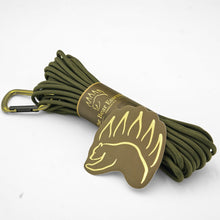


How to Tie the Snake Knot
Usage
The snake knot is a decorative knot for building flat, compact chains of cord — bracelets, key-fob lanyards, knife lanyards, and zipper pulls. It works by repeating one simple knot over and over: tie a unit, tighten it, flip the work, and tie the next, until the chain is as long as you want. Compared to a chain sinnet, the snake knot produces a flatter, more compact chain, which is why it's the go-to for slim items you wear or carry every day.
Why Learn the Snake Knot?
Search any paracord project — a keychain, a knife lanyard, a bracelet — and the snake knot shows up again and again, because one small repeating knot handles all of them. The chain's flat profile keeps items slim, the length is adjustable (just stop tying when it's long enough), and the same wrap adds grip when tied around a tool handle. It also works beyond paracord: tied off with an overhand stopper, it makes a clean fob or zipper pull even in natural cordage.
Common Uses
Everyday Carry
- Key-fob and keychain lanyards
- Knife and multi-tool lanyards
- Zipper pulls on jackets and packs
Crafting and Decorative
- Bracelets and neck lanyards
- A finishing knot for decorative work, such as finishing a monkey fist knot
Household / Workshop
- Gear handles and grip wraps on tools
Other Names
Category
|
Notable Features
- Flat, Slim Chain: The finished chain sits flatter and more compact than a chain sinnet, so lanyards and pulls stay slim instead of bulky.
- Adjustable Length: The chain is built one knot at a time — stop whenever it's the length you need. About 24 in (60 cm) of paracord makes an 8-knot lanyard.
- Adds Grip: Tied along a tool handle, the segmented chain gives your hand something to hold onto.
Similar Knots
Daisy Chain Knot vs. Snake Knot
- Advantage: The daisy chain (chain sinnet) builds length quickly.
- Disadvantage: Its chain is bulkier — the snake knot's flatter, more compact profile is better for slim worn items.
Diamond Knot vs. Snake Knot
- Advantage: These two work together rather than compete — the diamond knot is a common start and finish element for a snake-knot lanyard.
- Disadvantage: The diamond knot is a single knot, not a chain — it can't build length the way the snake knot can.
Security Level
Tied snug, the snake knot holds reliably for light decorative use, and extra knots improve its grip on slick cords — but this is a decorative knot, not a load-bearing one.
Downsides
- Time-Consuming: Every inch of chain is several individual knots, each tied and tightened — longer chains take a while.
- Can Loosen: If the knots aren't tied snug, the chain may work loose over time.
History
The snake knot as tied today is a modern craft technique, taught mostly through video tutorials rather than catalogued in the classic knot references — it has no entry in Ashley's Book of Knots. Its "Tibetan" alternate name points to a much older story: according to a cultural history published by Hoi Bo, the coiling, never-ending "snake" pattern traces back to the endless-knot family of Buddhist symbols — one of the Eight Auspicious Symbols in Tibetan Buddhism — with the hands-on knotted form emerging centuries later, shaped collectively by monks and artisans with no single inventor.
How to Tie a Snake Knot

Step 1
Melt or singe the paracord ends with a lighter so they don't fray and the inner core strands stay contained. A supple cord like our Premium Bushcraft Paracord is exactly what this knot was made for.
Step 2
Start with a double overhand knot joining your two pieces of paracord — or a single doubled cord, depending on the project — to anchor the pattern.
Step 3
Tie the first snake-knot unit: a half-hitch-style wrap of the working cord around the standing cord.
Step 4
Tighten the knot, then flip the work over and tie the same knot on the other side.
Step 5
Keep the flip-and-repeat rhythm going, tightening each knot as you go, until the chain reaches the length you want.
Step 6
Finish the working ends — an overhand stopper knot lets you trim the ends close (even in natural cordage), or you can melt and fuse the ends.
Pro Tip: Learning with two different-colored cords makes an enormous difference — you can see exactly which cord does what at every step. If you'd rather watch the wraps in motion, the Knot IQ app lets you play the snake knot's 3D animation step by step and turn it to any angle.
FAQ
How much paracord do I need for a snake knot lanyard?
About 24 in (60 cm) of paracord makes an 8-knot lanyard. As a rough planning figure, expect to use around 5.5 in (14 cm) of cord for every 1 in (2.5 cm) of finished chain, and about 7–9 ft (2.1–2.7 m) for a full bracelet.
Is the snake knot strong?
It's a decorative knot, not a load-bearing one. Tied snug, it holds reliably for light decorative use — lanyards, fobs, pulls — but it is not for heavy loads. When people quote "550 lb" figures, they're quoting the cord's rating, not the knot's; no knot-specific strength data exists.
Why does my snake knot chain twist instead of stacking straight?
You're not alone — learners across many tutorials report the chain spiraling after five or six knots, and honestly, no source documents a definitive fix. What the tutorials do agree on: tighten each knot fully before flipping, keep your tension even, and expect it to improve with practice.
Is the snake knot the same as the king cobra knot?
They look similar, and some people use the names loosely, but at least one knot-tyer argues they're structurally different — the snake knot finishing looser, with different shaping at the start and end. The question isn't settled.
Why is it called the Tibetan snake knot?
According to a cultural history published by Hoi Bo, the name links the knot to the endless-knot family of Tibetan Buddhist symbols, where the "snake" refers to the coiling, never-ending pattern rather than a literal snake. Today's paracord version is taught as a purely practical craft technique.
Important Notes on Safety
Keep the snake knot in its lane: it's for decorative and light utility use — lanyards, fobs, pulls, grip wraps — never for bearing weight, and never for anything where a failure would matter. And don't let a cord's printed strength rating stand in for the knot: a rated cord says nothing about what a decorative chain tied in it will hold.


