

Different Uses of a Palomar Knot
It has some far-ranging applications for not only fishing but also everyday life. Going fishing in the winter? It's a great knot to use when your fingers are cold because it doesn't require that much dexterity. It's also pretty forgiving if your fingers slip while you're trying to tie it. One of the coolest uses for this knot is the ability to tie multiple items in line. It can be as simple as leaving a longer tag end and attaching your hardware there. If you need to convert it back, you can just cut the tag end off at any point. If you'd like to see the Palomar from every angle before you're out on the water, the Knot IQ app shows it as a step-by-step 3D animation you can rotate and replay.How Do You Make the Palomar Knot?
Step 1:
Hold the fishing hook, and with your right hand, thread the string through the eye of your hook.
Step 2:
Hold the string with your left hand and push it back through to create a loop.
Step 3:
Pull the fish hook downward to give it a bit of length. Fold the loop across the main line.
Step 4:
Pass the loop through the circle you created. This makes a simple overhand knot.
Step 5:
Pass the hook through the center of the loop.
Step 6:
Just before you tighten up, dip into water to minimize possible friction.
Step 7 :
Flip that loop up over the knot and now pull the string in the opposite direction. With the tag end, you can cut it off or tie another hook to it. But pull tight, and you have your Palomar knot.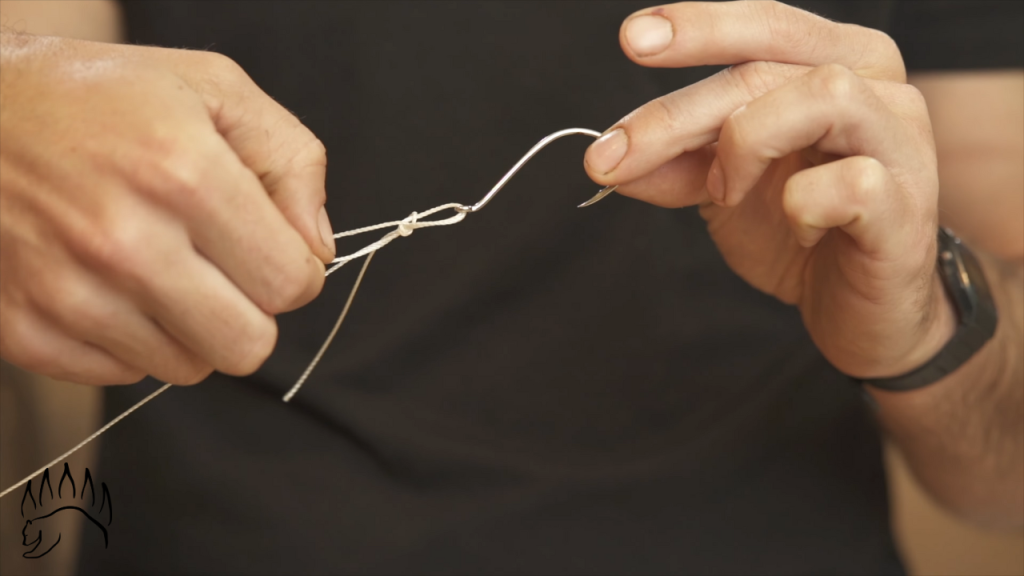
Common Palomar Knot Mistakes and Fixes
When using different types of lines, you'll find that some may cinch up a bit better than others. So, here are a few tips to help you through that. To fix this, make sure to slowly dress the knot by flipping the loop upwards, and as you're tightening it, just go carefully and make sure the loop stays there. Using braided lines? Some people opt to tie a double overhand knot, which is just an extra wrap, and that just adds extra strength.
Adding a Mid-Line Attachment or Dropper Hook
This knot is to add a midline item when you already have an established line. For this, you don't have to have access to the tag end.Want to add a carabiner midline?
Simply take a bight from the line which is just folding it down. Pass that little loop through the eye of your weight or carabiner or whatever you're using. Pull your line through and repeat the same process as before. Do the overhand knot, get that loop, and pass the weight through it. Finally, pull to tighten.
 The same could be applied when camping or stringing an item to a line. You simply create a loop, fold it over, pass your item through, and tighten the line.
Downsides of the Palomar Knot
- Big lures are awkward: the whole hook, lure or swivel has to pass through the loop, so a large spinnerbait or a treble-hooked topwater turns the tie into a wrestling match. Start with a doubled section well past the usual 6 in (15 cm), or switch to the Improved Clinch Knot for oversized terminal tackle.
- It eats line: because you tie it on doubled line, every Palomar costs roughly twice the line a single-strand knot does. That adds up fast when you are re-rigging all day.
- It sets hard: loose and unloaded it adjusts freely, but once it is cinched and a fish has leaned on it, the loop grips the eye and resists loosening. Most anglers cut it off and tie a fresh one rather than pick it apart.
- Not the pick for every job: it is a poor fit on heavy monofilament leaders, and for carp hair rigs a dedicated rig knot serves you better.
Similar Knots
Improved Clinch Knot vs. Palomar Knot
- Advantage: The clinch goes on without threading the lure through a loop, which is why it stays the standard fallback for big baits — see how to tie the Improved Clinch Knot if that is the situation you are in.
- Disadvantage: It is fussier to tie well, and it is not the first choice on braided line, where the Palomar's loop around the eye is far more forgiving.
Uni Knot vs. Palomar Knot
- Advantage: The Uni Knot is built from wraps rather than a passed loop, so lure size never matters, and the same knot doubles as a line-to-line join.
- Disadvantage: More turns to count and draw down evenly, so it is slower than the Palomar with cold hands.
Orvis Knot vs. Palomar Knot
- Advantage: The Orvis Knot was designed around light fly tippet, and its compact wrapped form is right at home on the fine stuff.
- Disadvantage: Narrower in scope: outside fine tippet the Palomar covers more ground, across monofilament, fluorocarbon and braid.
History of the Palomar Knot
The Palomar is a modern knot, which is why you will not find it in the classic mid-century knot references — it did not exist yet. The name belongs to Chester J. “Chet” Palomar, a Scout leader and retired firefighter from Pomona, California, who took his knot to the 1971 Fred Hall fishing show and tied it against the line companies' own knots on a testing machine. It won, DuPont adopted it, and the knot ran through the sports pages that year; the Bass Fishing Archives holds the scanned Pomona Progress Bulletin page from March 1971 that carried the story. Fishing editor Joe Cermele records the same origin at Outdoor Life. A second story crediting Palomar Mountain or a San Diego rod-and-reel club still circulates, but it lives in forum lore with no primary source behind it.FAQ
What is the one thing that makes a Palomar knot strong?
Seating. Every part of the knot has to draw up together at the eye of the hook, lure or swivel. If the loop ends up resting against the bottom of the eye or down on the hook shank, the knot is not finished properly and it can let go.Is the Palomar knot easy to untie?
Before you load it, yes — it slides and adjusts freely. After a fish has pulled on it, no. The loop grips the eye and the knot resists loosening, so most anglers simply cut it off and tie a fresh one.Does the hook stay free to move in a Palomar knot?
Yes. Tied and seated correctly the doubled line closes above the eye rather than pinning it, so the hook or lure can still swing and rotate on the knot, as Wikipedia's Palomar knot entry also notes.Important Notes on Safety
Two habits keep a Palomar honest. Keep the tag end and the main line parallel as you tie — strands that cross and twist rub on each other under load and can cut into the line, and fluorocarbon is the least forgiving about it. Then look before you cast: every part of the knot should draw up together right at the eye, never against the bottom of the eye and never down on the hook shank. A Palomar seated in the wrong place is the one that lets go.Be a master at tying knots with the Bear Essentials Knot Tying Kit — it includes a pocket field guide on tying the frequently used knots and two practice ropes. Subscribe to my Youtube Channel at The Bear Essentials.


